
Can Korean Cars Be Imported to the UAE? Age Limits and Restrictions Explained
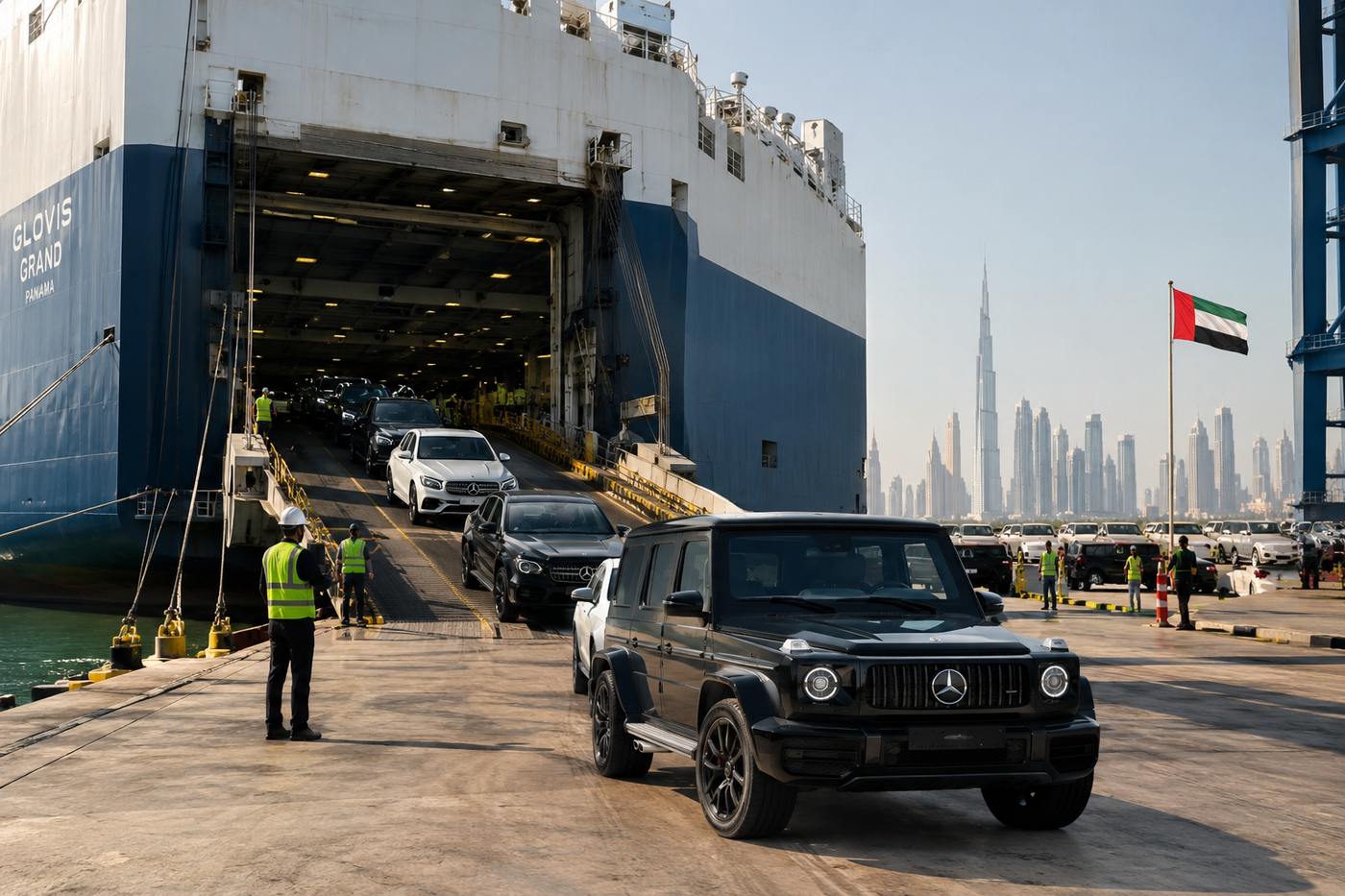
The UAE has become one of the significant destinations for Korean used vehicles, alongside Kyrgyzstan, Kazakhstan, Turkey and Libya. Cars leave Busan and Incheon for Jebel Ali every week.
But "can be imported" and "can be registered and driven" are two different questions, and most first-time buyers only discover the gap after the vehicle has already sailed. There are four gates. Three of them Korean cars pass easily. The fourth is where deals go wrong.
Gate one: age
The UAE restricts used vehicle imports to cars under 10 years old.
The detail that catches people: the clock runs from the manufacturing date, not the model year. A 2016 model built in late 2015 can fall outside the window even though every listing calls it a 2016. Before you commit to a unit, check the build date on the VIN plate or the title documents — not the advertised model year.
Vehicles older than 10 years need a pre-approval permit from the transport authority in the emirate of registration. It is not granted automatically and it should never be assumed at the point of purchase.
There is a separate route for vehicles over 25 to 30 years old, which can be classified as classics. That regime comes with special plates, annual mileage caps and a dedicated technical inspection. It exists, but it is a collector route, not a commercial one.
Gate two: drive side
The UAE registers left-hand drive vehicles only. Right-hand drive cars cannot be registered for normal road use, with narrow exceptions for approved classics.
This is a structural advantage for Korean stock that buyers rarely think about. Korea builds and drives left-hand drive. A Korean Palisade, Sorento or Genesis is on the correct side of this rule straight from the factory — no conversion, no exception request, no risk. A Japanese domestic-market equivalent is not.
If you have been comparing Korean and Japanese sourcing for the Gulf, this single line resolves a large part of the comparison.
Gate three: condition
Salvage, flood-damaged, written-off and heavily modified vehicles are restricted or rejected. Customs and the inspection centres look for structural damage, frame distortion and flood history.
Korea's domestic market is genuinely favourable here, and this is worth understanding rather than taking on trust:
Short ownership cycles. Korean owners replace cars quickly, so the export pool skews recent and low-mileage.
Mandatory periodic inspection. Vehicles are inspected on a regulated schedule, and those records exist.
Traceable history. Performance condition records and accident history are documented and travel with the vehicle.
The practical consequence: on a Korean unit you can verify condition on paper before the car is loaded. That is not equally true of every sourcing market.
Gate four: specification — the one that matters
Here is where most of the money is won or lost, and where an honest exporter has to say something inconvenient.
Passing customs is not the same as passing registration.
A Korean domestic-market car is not GCC specification. GCC spec is a formal certification — since January 2005, every new vehicle sold in the six Gulf states has required a GCC Conformity Certificate under Gulf Standardization Organization technical regulations covering safety, tyres and emissions. In hardware terms it means larger radiators, reinforced air conditioning condensers, corrosion protection for coastal humidity, and fuel systems calibrated for locally available octane.
A Korean domestic car is engineered for Korean conditions instead. The hardware is not defective. It is calibrated for a different environment.
Two consequences follow:
Extra approval before registration. If customs identifies the vehicle as non-GCC spec, you need a conformity certificate from the Ministry of Industry and Advanced Technology before the transport authority will register it. Non-GCC vehicles can also add one to two weeks to customs processing.
A resale discount. A non-GCC spec vehicle can lose an estimated 15 to 30 percent of resale value against an identical GCC-spec car in the UAE market. Insurance is typically loaded. Authorised dealer networks generally do not honour a manufacturer's warranty on a vehicle imported from another market. Many local dealers will not take a non-GCC car in trade.
None of that stops the import. It changes the arithmetic.
The question that actually decides your purchase
Before you buy a single unit for the UAE, answer this:
Is the car going to be registered in the Emirates, or re-exported through them?
Re-exported. If the vehicle enters a UAE free zone and leaves for Africa, Central Asia or another destination outside the Gulf, GCC specification is largely irrelevant — the destination market's rules apply, not the UAE's. Customs duty and VAT are suspended while the goods sit in the zone, and on a qualifying re-export outside the Gulf no duty becomes payable at all. Source on condition, mileage and destination demand. Korean domestic spec is fine.
Registered locally. You are accepting the non-GCC discount. Buy only where the spread still works after 15 to 30 percent comes off the resale figure. If the deal only makes sense when you ignore that number, it does not make sense.
The short version
A clean, under-10-year, left-hand drive Korean vehicle with documented history clears the UAE's import gates without difficulty. Korea is a strong sourcing market for the Emirates, and the drive-side and condition advantages are real.
Whether a specific car is a good buy depends entirely on which side of the register-or-re-export line it sits on. Any exporter who tells you every Korean car sells easily in Dubai is selling you a shipment, not advice.
At KingStone Motors we tell you which side of that line a vehicle falls on before you pay for it — including when the answer is that you should not buy it.