
Korean Domestic Spec vs GCC Spec: Cooling, AC, Warranty and What It Really Costs
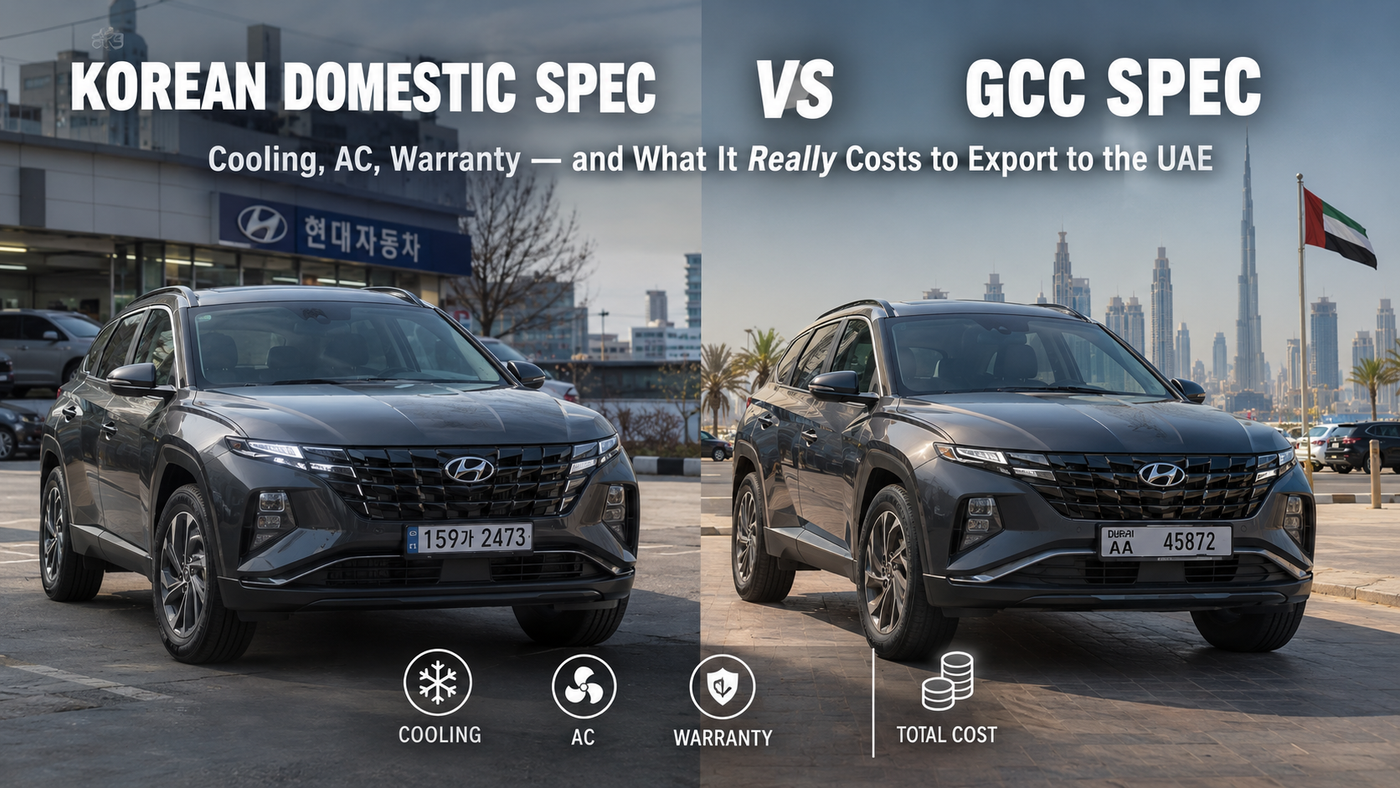
Most exporters avoid this article. We are writing it because getting this wrong costs a buyer more than the car saved them, and because you will find out eventually — better from us, before you pay.
GCC spec is a certification, not a marketing word
"GCC spec" gets used loosely in listings. It has a precise meaning.
Since January 2005, every new motor vehicle sold in the six Gulf states — the UAE, Saudi Arabia, Kuwait, Qatar, Bahrain and Oman — has required a GCC Conformity Certificate, issued under the technical regulations of the Gulf Standardization Organization. Those regulations cover vehicle safety, tyres and emissions as separate standards. The UAE applies a Euro 4 emissions limit for motor vehicles.
So GCC spec is not a description of how a car feels in the heat. It is a documented certification that the manufacturer obtained before first sale in the region.
A Korean domestic-market vehicle was certified for Korea, not for the Gulf. It does not carry that certificate. That is the whole issue, and everything below follows from it.
What GCC-spec cars are generally built with
Vehicles homologated for the Gulf are typically adapted for the operating environment. Commonly cited differences include:
Increased cooling capacity — larger radiators and reinforced air conditioning condensers, for sustained ambient temperatures above 50°C
Air conditioning calibration for high-heat operation, with more frequent cabin and sand filter service intervals
Corrosion protection tuned for coastal humidity and salt
Fuel system calibration for locally available octane — 91 RON is the practical minimum in the region
Tyre and pressure specification appropriate to extreme surface temperatures
Heat-tolerant wiring harnesses and cooling lines
One honest caveat, because you will not get this from most sellers: the actual hardware difference varies by manufacturer, model, generation and trim. For some models the gap between a domestic-market car and a regional-market car is meaningful. For others it is small or limited to calibration and equipment rather than components. Nobody can tell you the delta for a specific car without checking that specific model and build.
Anyone who tells you every non-GCC car will overheat is guessing. Anyone who tells you the difference is purely paperwork is also guessing. Check the model.
The four consequences that are not in doubt
Whatever the hardware difference on a given model, four things follow from the missing certificate, and these are consistent.
1. An extra approval before registration. If customs identifies the vehicle as non-GCC spec, you need a conformity certificate from the Ministry of Industry and Advanced Technology before the transport authority will register it. Ministry booths operate inside registration centres, so it can often be handled in the same visit — but it is an extra gate, and non-GCC vehicles can add one to two weeks to customs processing.
2. No manufacturer warranty from the local dealer network. Authorised UAE distributors generally do not honour a manufacturer's warranty on a vehicle imported from another market. A three-year-old Korean car with factory warranty remaining in Korea will typically not have that warranty serviced by the UAE dealer network. Whatever warranty you are offered instead is a trader warranty — worth exactly as much as the business behind it, and worth nothing if that business closes.
3. Higher insurance, and sometimes refused cover. UAE insurers price non-GCC vehicles as higher risk. Expect a loaded premium. A minority of insurers decline comprehensive cover on imports entirely. Get a written quote before you buy the car, not after it lands.
4. The resale discount — the number that decides the deal. A non-GCC spec or grey-import vehicle can lose an estimated 15 to 30 percent of resale value against an identical GCC-spec car in the UAE market. Many local used car dealers will not accept a non-GCC vehicle in trade at all. Some official service centres decline work on imported units.
That last figure is a widely reported market estimate rather than an official statistic — but it is consistent across sources, and no serious buyer should model a UAE resale without it.
How to check whether a car is GCC spec
Before you buy anything advertised as GCC spec, verify it. Cross-check at least two of these:
The vehicle identification plate in the driver-side door frame
The owner's manual — regional manuals carry sections specific to Gulf operation, such as desert-mode AC, sand filter intervals, minimum fuel octane and tyre pressures for extreme heat
Arabic text on the side mirrors, common on regional-market cars
A VIN check through the relevant UAE government portal, which shows registration origin
The GCC compliance certificate itself, if the seller has it
A listing that says "GCC spec" and cannot produce evidence should be treated as non-GCC until proven otherwise.
So when does a Korean domestic-spec car still make commercial sense?
Three cases, and only three.
1. Re-export. This is the strongest one by a wide margin. If the vehicle enters a UAE free zone and leaves for Africa, Central Asia or another destination outside the Gulf, GCC certification is largely irrelevant — the destination market's rules apply, not the UAE's. Customs duty and VAT are suspended while goods sit in the zone, and on a qualifying re-export outside the Gulf no duty becomes payable at all. This is how most Korean volume genuinely moves through Dubai.
2. The model is not available locally in GCC spec, and the buyer accepts the discount at the point of purchase rather than discovering it at the point of sale.
3. A buyer with a defined exit timeline who has already priced the 15 to 30 percent haircut into the deal and still has margin.
Outside those three, a GCC-spec car bought locally usually wins. We would rather tell you that than sell you a container.
The one calculation to run
Take your landed cost. Take your realistic UAE resale figure. Cut the resale figure by 20 percent as a working assumption. Does the deal still work?
Yes → buy it, with your eyes open.
Only if you ignore the cut → it is not a deal, it is a bet on finding a buyer who does not check.
At KingStone Motors we run that number with you before the vehicle is sourced, and we tell you when the honest answer is that this particular car should go somewhere other than the UAE domestic market.