
Duty and VAT on Arrival at Jebel Ali: What You Actually Pay
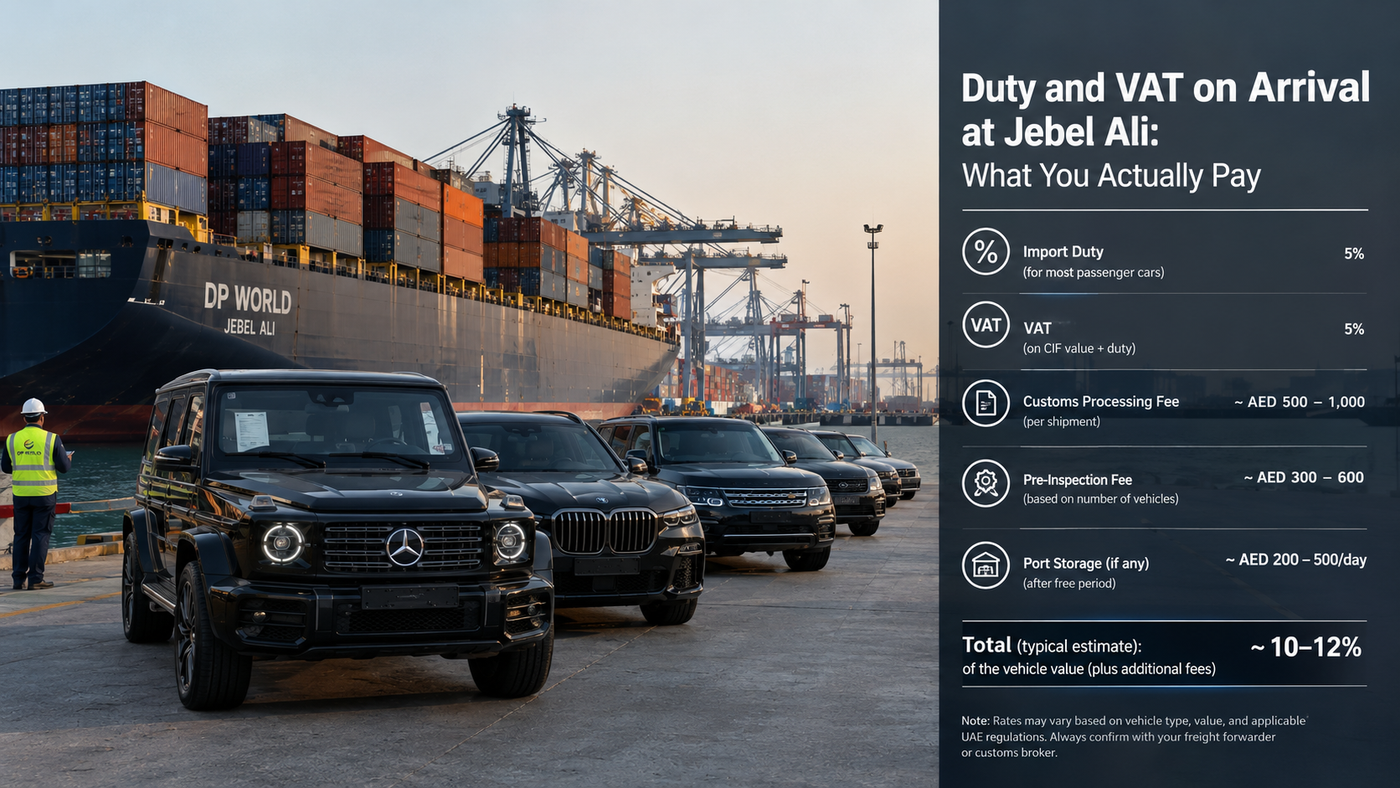
Two numbers get quoted constantly and both are slightly wrong. The rates are right; the way people apply them is not. Here is what actually comes off your margin.
The headline rates
Customs duty: 5 percent of CIF value
VAT: 5 percent
The detail that matters is what each percentage is applied to.
CIF means cost, insurance and freight — the vehicle price plus marine insurance plus ocean freight, combined. Not the purchase price alone. Buyers who budget 5 percent of the invoice figure underbudget every time.
VAT is applied to the duty-inclusive value, not to the CIF figure. So it stacks on top of the duty rather than sitting beside it. The effective combined tax is therefore roughly 10.25 percent, not 10.
Worked example
Take a vehicle with a CIF value of USD 20,000 — that is the car, the marine insurance and the ocean freight combined.
Customs duty at 5% of CIF: USD 1,000
That brings the duty-inclusive value to USD 21,000
VAT at 5% of that figure: USD 1,050
Total tax: USD 2,050
That is 10.25 percent of CIF, not 10 percent. On a single unit the difference is small. Across a container of four cars it is real money, and across a year of shipments it is a line item.One consequence people miss: because duty is charged on freight as well as on the car, your shipping method has a small tax effect. A cheaper sailing reduces your freight bill and your duty bill together. It is not a large effect, but it runs in the same direction as the obvious saving rather than against it.
The costs that are not tax
Tax is not landed cost. On top of duty and VAT, budget for:
Customs broker fees
Port handling and terminal charges
Storage and demurrage if the shipment is held — every day a car sits in a bonded facility after arrival costs money, and a documentation hold of a few days adds up before the underlying problem is even resolved
The conformity certificate, where the vehicle is not GCC specification
Technical inspection
Registration and plates
Industry estimates put total import cost at roughly 13 to 18 percent above the purchase price once all of it is stacked. On a first shipment into a new corridor, budget the top of that range and be pleasantly surprised rather than short.
We deliberately do not publish dirham figures for broker fees, port handling, inspection or registration. They vary by emirate, by agent and by vehicle, and the published numbers we found were inconsistent enough that quoting them would be misleading. Get those from your own clearing agent and treat them as your numbers, not ours.
The free zone route — where duty can be zero
This is the part that changes the arithmetic entirely for traders, and it is the reason Dubai works as a hub rather than just a market.
Goods imported into a designated free zone such as Jebel Ali Free Zone are held under suspended customs duty and VAT, because they have not entered UAE customs territory. The vehicle is physically in Dubai. Legally, for customs purposes, it has not arrived.
From there, two paths:
Path one — re-export outside the Gulf. If the vehicle leaves the zone for Africa, Central Asia or any destination outside the UAE and outside the Gulf states, no customs duty becomes payable at all. The suspension becomes a permanent exemption for that shipment.
Path two — into the UAE mainland. The moment the vehicle moves from the free zone into the domestic market, a transit-out declaration is filed and the standard 5 percent duty becomes payable on CIF value, plus applicable VAT. The liability exists at the point of mainland transfer, not at the point of arrival.
There is also a separate mainland route: goods imported outside a free zone with the declared intention of re-exporting them can be covered by a deposit or bank guarantee equal to the duty instead of paying it upfront, with the deposit released once re-export is confirmed. The conditions on that route are specific — confirm them with your broker before relying on it.
Two warnings attached to the free zone advantage
You need a customs code. Every free zone company importing or exporting must hold a registered customs importer and exporter code with the local customs department. This is not optional and not something to sort out after the vessel arrives.
The paperwork is enforced. Moving goods out of a free zone without completing the correct customs declaration is treated as smuggling under Gulf customs law, with fines up to multiples of the duty owed and possible imprisonment. UAE courts have upheld criminal convictions for exactly this. Whatever the free zone saves you, it does not save you from the declaration.
Every shipment needs to be tracked individually: which units have crossed into the mainland with duty paid, and which remain in free zone status with duty suspended. Companies that sell into both channels and do not track this shipment by shipment create a liability that surfaces later, with penalties attached.
The practical read
Selling into the UAE domestic market? Budget 10.25 percent tax on CIF and 13 to 18 percent total over purchase price. Then apply the non-GCC resale discount if the car is Korean domestic specification, because that is a larger number than the tax.
Stocking in Dubai to distribute onward into Africa or Central Asia? The free zone route removes the tax layer entirely on qualifying re-exports. This is where the margin actually sits, and it is why the Emirates function as a gateway rather than an end market for most Korean volume.
Getting the declaration wrong? More expensive than either.
At KingStone Motors we prepare the origin-side document set before the vehicle is loaded, with the invoice, export certificate and bill of lading built to match — because a documentation hold at Jebel Ali costs more per day than most people expect.