
Why Korea Has So Many Low-Mileage Supercars: The Corporate-Car Effect
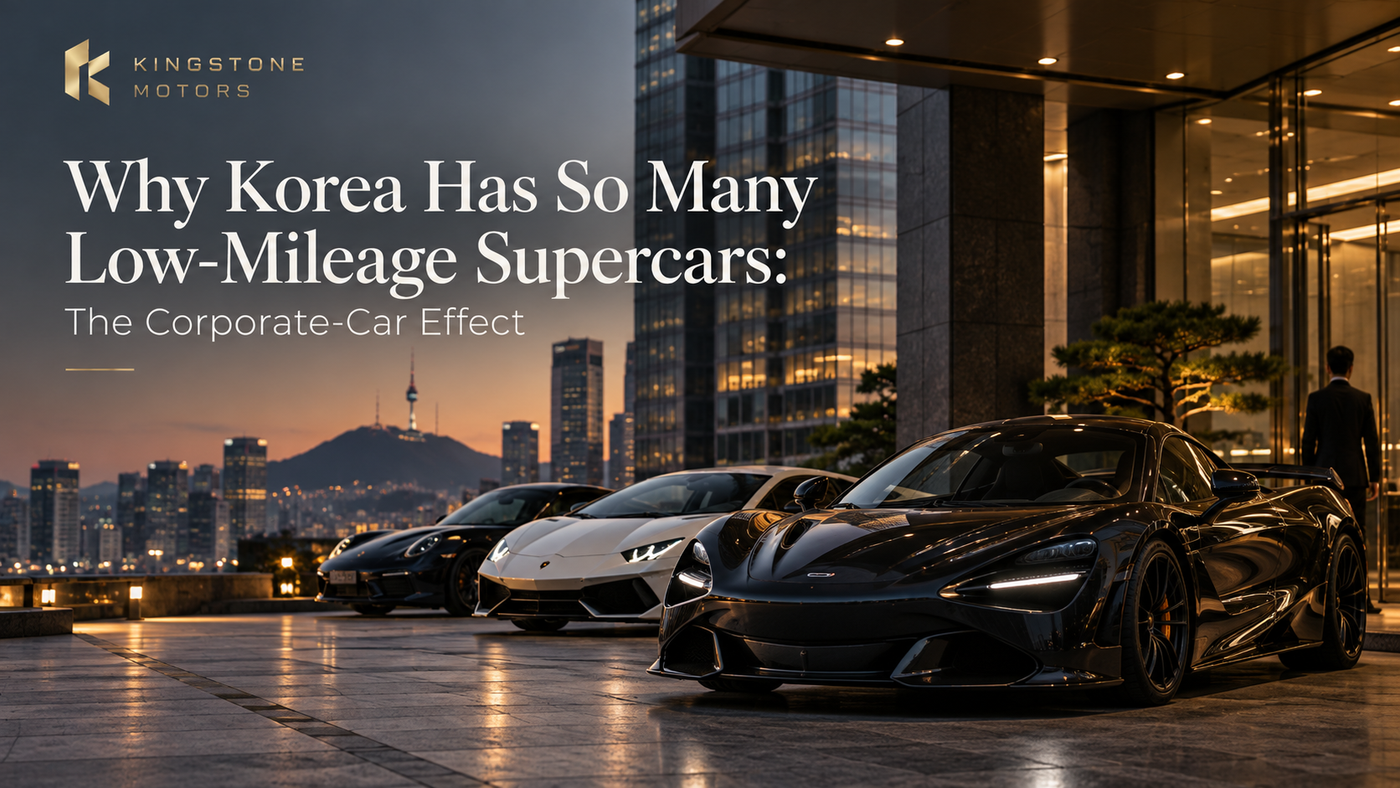
South Korea has become an unusually productive sourcing market for late-model Ferraris, Lamborghinis, Rolls-Royces and other high-end cars with comparatively low recorded mileage. The easy explanation is that Koreans simply do not drive supercars very much. The more useful explanation is structural: many of these cars entered the market as corporate assets rather than as an owner's only daily vehicle.
The numbers behind Korea's corporate-supercar market
According to the Korea Automobile Importers & Distributors Association data reported by The Korea Herald, Ferrari and Lamborghini each registered 158 vehicles in Korea from January through May 2025. Corporate buyers accounted for 89% of Ferrari registrations and 78% of Lamborghini registrations. Rolls-Royce was at 71% and Bentley at 67%.
Those percentages are often repeated without their date. They are January–May 2025 figures, not 2026 figures.
Korea has tried to discourage private use of expensive company cars. Since 2024, newly registered corporate passenger cars priced at KRW 80 million or more have received distinctive light-green licence plates. On 28 May 2026, Korea's National Tax Service announced investigations into 19 corporations suspected of tax evasion and private use of company-owned luxury vehicles. The 19 companies owned 90 high-priced vehicles worth approximately KRW 30 billion in total.
The pressure is now visible in new-car demand. From January through May 2026, Korean registrations fell year on year by 39.9% for Ferrari, 4.4% for Lamborghini and 17.4% for Rolls-Royce, even while Korea's broader imported-car market grew.
Why this can create low-mileage export supply
Corporate ownership does not automatically cause low mileage. The connection is an inference, not an official statistic. It is nevertheless commercially plausible for several reasons:
A company owner or executive may have several vehicles, so mileage is divided across the fleet.
A supercar may serve as a status, entertainment or occasional-use asset rather than the primary commuter car.
Short lease and ownership cycles can return relatively young vehicles to the secondary market.
Seoul's congestion, expensive parking and extensive public transport make a low sports car inconvenient for routine travel.
Increased tax scrutiny can make an underused corporate supercar harder to justify, encouraging disposal.
This combination can produce exactly what an overseas buyer wants: a recent model, low kilometres and meaningful depreciation from the Korean new-car price. It does not mean every Korean car is a bargain or every odometer is trustworthy.
What a buyer must verify
A low number on the dashboard is only the start. Before purchasing a supercar in Korea, request a VIN-level file containing:
Current registration and ownership information.
Exportable title status and a lien or seizure check.
Korean insurance-loss and accident history.
Manufacturer or authorised-dealer service records where available.
ECU or diagnostic mileage readings when the model allows them.
Paint-depth readings, underbody photographs and a cold-start video.
Evidence of flood, fire or structural damage checks.
Photographs of tyres, brake discs, front lift, carbon components and the underside of both bumpers.
Low mileage with poor storage, old tyres and missed annual servicing can be worse than higher mileage with complete maintenance. On exotic cars, time-based servicing matters even when the vehicle barely moves.
What the corporate history does—and does not—tell you
A former corporate car is not automatically abused. Nor is a privately registered car automatically better. The useful questions are who controlled it, how it was maintained, whether the use was documented and why it is being sold.
Korea's real advantage is not a magic source of cheap supercars. It is a deep, transparent and frequently rotating premium-car market where disciplined buyers can compare multiple vehicles and inspect the actual car before export.
KingStone Motors sources vehicles across Korea, checks the history and physical condition, documents the purchase and manages deregistration and export. Send us the model, year, colour and maximum landed budget to receive a VIN-specific shortlist.
Buy a vehicle from South Korea
To source, inspect and export a vehicle from South Korea, contact KingStone Motors:
English WhatsApp: +82 10-3410-7410
Russian WhatsApp: +82 10-5956-5094
Sources
The Korea Herald: corporate registrations of high-end imported cars
Korea National Tax Service: investigation into private use of corporate supercars